Second Sunday in Lent
John 3:1-19
March 1, 2026
Themes and parallels. Threads and lattices. Connections. When you miss the connections, the themes, the threads that run through Scripture, you miss everything.
Over the years critical scholars, or as our confirmation kids just learned, scholars of “higher criticism,” often accuse St. John the Apostle of being overly simplistic in his Gospel. That his Greek grammar isn’t as complex or advanced as the gospels of Matthew, Mark, and especially Luke, and that he seems to jump around and not follow a historical timeline. They try to insert a drop of doubt into the text and suggest that it’s a secondary text, that John didn’t have the education of the other evangelists.
I contend, however, along with the historic and orthodox church (and I don’t mean the orthodox church body but the church of history and faithfulness to Scripture), that John wrote his Gospel precisely as God wanted him to, and that his gospel, above all others, is more connected to and reliant upon the great golden thread or lattice that runs throughout Scripture.
Right away, John chapter 1, the words, “In the beginning” are used. That’s Genesis 1. There’s creation, there’s sacrifice, there’s the hovering and working of the Holy Spirit, there’s trees, and there’s water. And the Gospel of John is chalk-full of water, and not just water, but water, blood, Spirit – it’s all there, and yes, even trees. And the first few chapters beautifully connect us back to Genesis 1 through 3, to creation, to the fall, and to God’s redemption.
To read John is to read Genesis anew. See, Genesis 1, yeah that was creation of the world and that’s wonderful and it’s pretty much essential, but John chapter 1 is new creation – it’s the whole point. In Genesis 2 there was a wedding, the marriage of Adam and Eve our first parents, and in John 2 there is a wedding and guess who’s present? Mary the mother of God and Jesus, God in the flesh, and Mary says, “Do whatever HE says,” for Jesus is the new and faithful Adam. In Genesis 3, sin enters the world through one man, and in John 3, redemption is accomplished by the sacrifice of one man, the Son of God.
Connections, connections, connections. And Nicodemus, a teacher or ruler of the Jews, he should have understood these connections, but he missed them. Jesus even pokes at him a bit for missing it. He says, “You are the teacher of Israel and yet you do not understand these things?”
Fact is that, from kindergarten, we are taught to read left to right, top to bottom. Most books we read, be they fiction or non-fiction, follow a chronological sequence: this happened, then this happened, then this happened, you learn A, then you learn B, then you learn C. We’ve been taught to think this way – very rational, very deductive. Thesis, and three supporting points.
I remember watching a movie, many years ago, called Memento. And unlike most movies or sitcoms on TV where A leads to B leads to C and then back to A, Memento was all backwards; it was non-linear. This movie might come across as unnerving at first, but once you get over the lack of linear, chronologicalness, it’s a really cool movie.
Well, when we read the Scripture, sometimes we need to take several steps back – go all the way back to the beginning – in order to get the message, and John 3 is certainly one of those passages where we just have to get off the chronology and find the golden thread.
Nicodemus could not do it; at least not when he first encountered Jesus. He could not make the connection between creation and new creation. I don’t know of Nicodemus was stuck in the pharisaical, legalist mindset where he thought his salvation was by his own works, or if he just had a mind block between the Torah and Jesus’ teaching.
But Jesus isn’t speaking in riddles here; He’s not trying to be confusing.
The first thing Jesus says, after Nicodemus comes and compliments Him, although why he complimented Jesus is a bit speculatory. Some say the pharisee was just buttering up Jesus in order to pose a potential gotcha question, such as what the other religious leaders did on more than one occasion. Others say – and in fact if you watch “The Chosen,” they take this approach, that Nicodemus was searching for something more than pharisaism and that Jesus’ teaching intrigued him. I won’t take a hard stand on it either way, because it’s really not the main point of the text.
The first thing Jesus says to Nicodemus is, “Truly, truly, I say to you, unless one is born again, he cannot see the kingdom of God.”
There’s a newer translation of the Scripture called the “Evangelical Heritage Version,” and it was translated primarily by confessional Lutherans, and it’s published by Northwestern Publishing, which is the WELS synod, and it is the formal translation for their church body. I have this translation in my office, and I’ve used it from time to time. It’s a good translation.
John 3:3 reads this way in the EHV translation: “Amen, Amen, I tell you: Unless someone is born from above, he cannot see the kingdom of God.” And interestingly enough, the Greek word for “above” or “again” or “anew,” is most often translated as “above” in other passages of Scripture. In fact, just a few verses later, in verse 31, the same word is used when Jesus says, “The One who comes from above is superior to everyone.”
But more importantly, the main push of the word in Greek is the idea of new beginning, new creation, at least in verses 3-16.
Unless one is created a new, born from above, born again, he cannot see the Kingdom of God.
Nicodemus misses the whole point. He might even think Jesus a bit crazy for suggesting that a person must crawl back into his mother’s womb and be born. It’s scientifically, rationally impossible.
Pharisaical teaching asserted that, for a person to be saved or have favor with God, that a person must follow the law and do good works. And so, Nicodemus naturally falls into the “I have to” mode. In fact, he probably came to Jesus hoping to have a typical rabbinical conversation about works of the law – how many steps one can take before breaking the Sabbath and all that sort of stuff. So, when Jesus throws the “you must be reborn” or “there must be new creation,” it’s totally out of left field for this pharisee.
But Jesus says nothing in riddles here; what He says is clear. Eden was a type of “kingdom” in which God’s first people, Adam and Eve dwelt. It was all His creation, but Adam and Eve were His special creation because they were given authority to rule over His creation, to act on His behalf.
But Adam and Eve died. Sin entered the world through that one act of disobedience, and death followed closely behind. And from Adam on until the Lord’s Day, death is always with us.
For humanity to escape this vicious cycle of natural birth and certain death, he must be removed from that force which brings death, the force called sin, and be newly created by God into an existence where sin and death no longer rule – new creation – born from above – born again.
And the way God does this rebirth is EXACTLY the way He did it in Eden. In Eden, God created by Spirit, Water, and Word, and in new creation, God creates by Spirit, Water, and Word.
Think about it. Adam didn’t lift a finger to be created. He didn’t choose it, he didn’t commit to it, he didn’t decide it. He didn’t say from his clay form, “I will myself to be alive,” none of it! It was 100% God’s work for him. God shaped and molded Adam and breathed life into Adam and he was alive; he was born, he was – as the Greek says – generated.
And now Jesus comes along, the Word of God in flesh speaks and says, “You must be generated anew.” Nicodemus is thinking “what do I have to do,” and Jesus comes and says, “no, you need to be born – from above, not from below, but from above – you need to be generated again,”
Nicodemus doesn’t get it.
Then Jesus continues on and explains in detail how this regeneration, this rebirth works. He says that this rebirth is by water and the Spirit.
Now, this verse, verse 5, is one of the most abused and misused verses in Scripture. In fact, all of chapter 3 is very abused, but verse 5 particularly. “Truly, truly, I tell you: Unless someone is born of water and the Spirit, he cannot enter the kingdom of God!”
Now, you don’t have to be a Greek scholar to know what Jesus means in this text – you just need to not be stubborn and stuck in some sort of “baptism doesn’t save” way of thinking. See, if you insist that salvation is, at least in some way, maybe even a small way, a thing you do or you contribute to, then Jesus’ words in verse 5 have a very different meaning then if you acknowledge that salvation and new life is entirely God’s work alone on your behalf.
“But I have to at least say ‘yes’ or accept or agree or…something…” Did Adam say “yes”? Did Eve say, “I have decided to be a woman, no turning back…no turning back…”? “Well then we’re all just robots and Adam and Eve were just robots.” Well, they weren’t very good robots because they both disobeyed God and brought sin into the world, didn’t they?
The language we use compared to the language Jesus uses – it’s like night and day sometimes, isn’t it? We fall headlong into the same trap of misunderstanding as Nicodemus. Why? Because it is our nature to want to be like God. And so, like the pharisee, we always want to caveat the work of salvation with a bit of human effort or responsibility. Eat the fruit and play your part. Jesus says, “You need to be regenerated,” and we say, “How much regenerating do I need to do?” Jesus says, “You must be born from above,” and we say, “How much birthing of myself must I do?”
And then, in an effort to hide our attempts at self-birthing works-righteousness, we misinterpret verse 5. “Unless someone is born of water and the Spirit, he cannot enter the kingdom of God.” How many times have I heard people say that these are two separate births – water and the Spirit – being born naturally and then being born spiritually? It’s just not correct.
If I were to say to you, “The car is red and green,” would I be saying that there’s two different cars, one red and one green? Or, if I were to say to you, “You must sing stanza one and stanza two,” would I be telling you to sing two different hymns? No.
And verse 6 is not a parallel to verse 5. A lot of people like to say it is, but it’s not. The Greek grammar in verse 5 asserts that birth by water and the Spirit is a single birth. Further, verse 6, when speaking of flesh giving birth to flesh, has more to do with the sinful nature than natural birth. That which is generated by flesh is the same sinful flesh, and that which is generated by the Spirit is spirit.
Being born from below is merely being born sinful by more sinful flesh. It doesn’t get us anything necessary for the kingdom of God. But being born from above is being born of the Spirit by water…just like in Eden.
THERE is the parallel. What Jesus is saying to Nicodemus, and why Nicodemus should understand this plain teaching, is that first creation and new creation work the same way. It is God speaking His Word through water and the hovering Spirit making new life. It’s baptism!
Jesus is speaking of new creation, juxtaposed to first creation. Where in first creation, man and all things was generated by water and the Spirit, now in new creation, man is reborn by water and the Spirit. This helps us understand why Jesus was baptized, because His baptism makes all water a living and flowing water through which salvation is accomplished by God and the Word. It’s Father and Son and Spirit – it’s Trinity all wrapped up in the water and the rebirth of new citizens in His kingdom. And there we have the great lattice that runs from page to page.
These are all great heavenly mysteries – the mystery of salvation and eternal life by His death on the cross – mysteries which Jesus is revealing to Nicodemus who thought that his salvation was by his own works. Jesus says, no, but salvation is always the work of God from beginning to end, from everlasting to everlasting, from creation to new creation to new heaven and new earth, God is and has made all things new in Jesus.
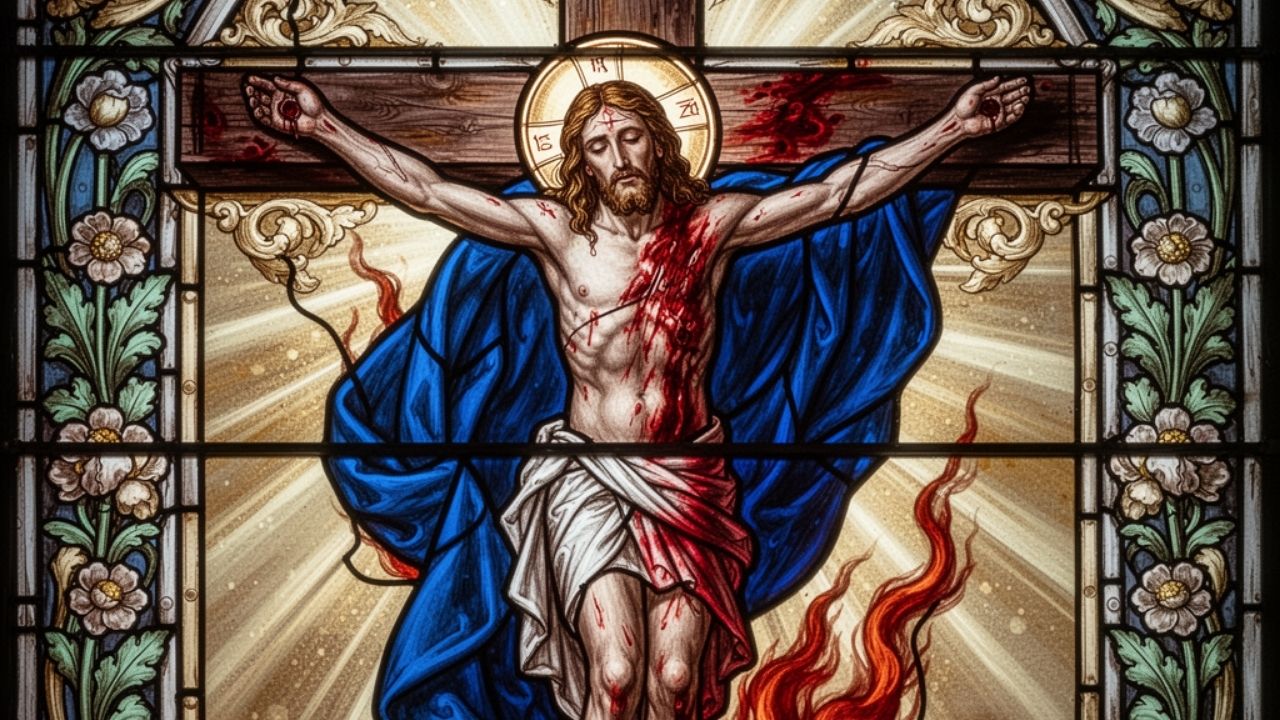
And by faith which clings to these promises and holds on to all that God does, we are brought near to Him, to His cross where we look up and see our salvation flowing like blood and water from Jesus’ side. Adam was created with this faith, just as God’s new creation – you and me – we are recreated with the same faith. But Adam and Eve, they listened to the wrong word and their faith shifted to follow the words of sin and death.
But Jesus, His faith never wavered, never shifted, even unto death on a cross. This is why it is ultimately HIS faith which saves us, and His Gospel communicated to us by words, awakens faith in us as well.
All the elements of creation – water, blood, flesh, Spirit – it’s all there on the cross – even the tree itself which brought condemnation to the world, now breeds life for all who believe.
Themes and parallels. Threads and lattices. Connections. Don’t miss them; don’t let rationalism and timelines and chronologies interfere with what the Lord has done for you and continues to do for you by water and the Spirit, by body and blood, by Word and promise. Amen.