

Devotional
or
Didactic?
The difference between hymnody and “praise music” as its been commonly called is that hymns aim to be didactic while “praise music” aims to be devotional. Hymns teach the faith; “praise music” stirs the soul.
Here’s the clincher. At the center of the so-called “worship wars” of the LCMS is the question of devotional vs. didactical. Is the liturgy and is the music meant to stir the soul or teach the faith? Or can they do both?
Where do we turn to answer these questions? We must go to the great “conductor of the choir immortal,” Christ Jesus and His Word. Consider the angels and archangels and the whole company of heaven. What do they sing? Devotional or didactical? Are they singing stirring refrains to emotionally move God, or are they singing His Word and responding to His holiness and wisdom through words and chant which teach? I think we know the answer. They are a didactic chorus of doctrinal words and stanzas which not only praise and thank the Lord for His greatness by singing things faithful to Him, but they are also teaching us of the greatness of the Lord by singing clear, bold statements of faith.
For example, as the whole company of heaven sings, “Holy, Holy, Holy is the Lord of hosts, the whole earth is filled with His glory,” this is not merely some soul-stirring phrase. No, this is doctrine! It is a confession of faith meant to teach. Might it draw an emotional response? Sure, but the devotional is secondary to the didactic.

21st century culture lives and breathes and thrives off emotion. They’ve abandoned religion; they’ve abandoned reason. Today, all they have left is their emotions, the “I feel” approach to discerning all things. They have no objective right or wrong; they know not a distinction between good and evil. What they know is how it makes them feel. If it makes them feel good about themselves and their choices, they call this “good.” If it makes them feel uncomfortable or uneasy or weak, they call this “bad.”
But this is society; it’s not the church, at least it shouldn’t be. Yet, how many Christians have succumbed to society’s pressure to judge right and wrong by emotion? Well, just look at the division in the church! There are church bodies that literally embrace emotionalism, calling it ‘spiritual’, and compromising the Word of God to do it. They’ve become places of therapy; they judge faith by how a person feels about herself. And Scripture? It is more of an appendage then the source and norm of the Christian faith and life.
And naturally, the music is solely emotion-stirring.
A Time of No Religion?
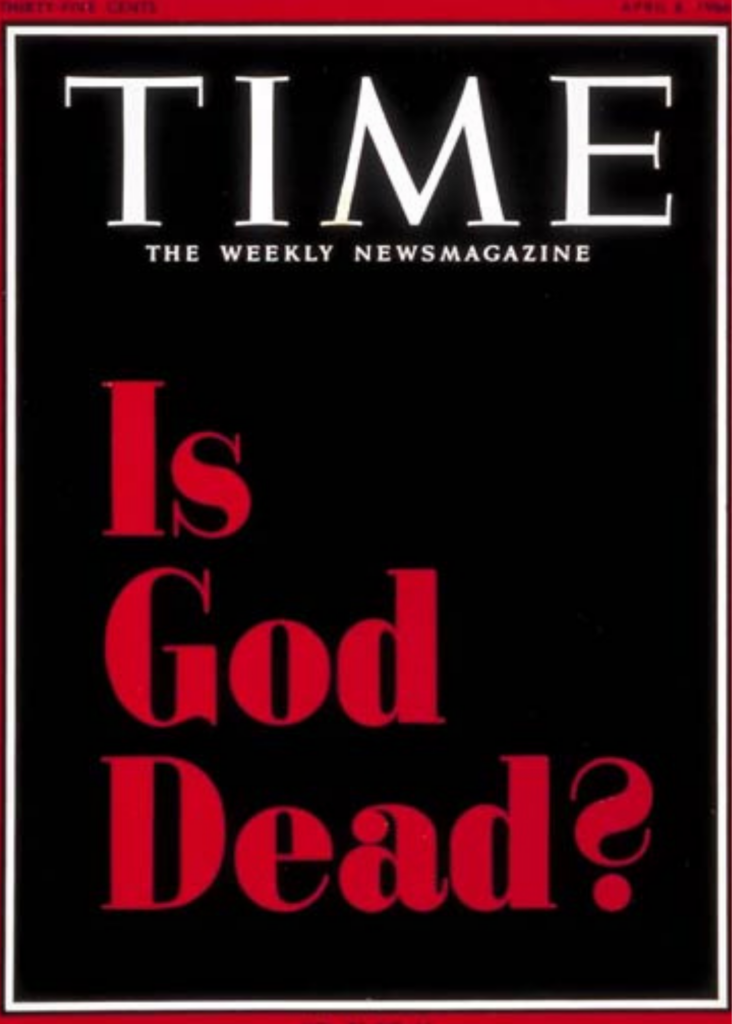
It was April 8, 1966 when Time Magazine published its cover article, “Is God Dead?” What was going on in society and in the churches that such a question should even be considered? More importantly, what does this have to do with hymnody?
The movement behind the question was the Secular Theology Movement where the influence of humanism and secularism in society was leading to a growth peak and abrupt decline in church membership. There was also a philosophical shift in how people understood God, religion, and worship.
The late Dietrich Bonhoeffer, while locked away in his prison cell in 1943 for resisting Nazism and attempting to assassinate Hitler, wrote: “We are proceeding toward a time of no religion at all.” And 23 years later, Time Magazine shows his prophecy was beginning to realize.
As a reaction to this societal shift away from God and toward humanism, some churches simply embraced the movement and celebrated it. This was the churches of higher criticism such as the liberal wing of the Lutheran churches (today the ELCA church), the Methodists, the liberal wing of the Presbyterians, and the Episcopal church. The evangelical churches (Baptists, spiritualist churches, nondenoms) all cried out for “revival” and sought to develop new and emotionally stirring music and liturgies. They even developed the “Church Growth” model which sought to do away with the old and historic liturgies and hymns and write new music which was more adaptable to culture and lowered the didactic bar.
In both cases the church erred. The liberal churches should not have embraced the culture and the evangelical churches should not have abandoned the historic practices and hymns. Because in both cases, they pandered to society rather than faithfully abiding in Christ and His Word. They either thought the church was finally being liberated from oppressive things of the past, or they worried that the church would die if things weren’t changed, bars lowered, and the look, feel, and taste of the church’s worship be more attractive to the world.
Hymns Teach the Faith that Lasts
Hymns Connect Us to Our Past
Consider the following “praise song” that has been well-sung in evangelical circles:

We can say certain things about this song, things we might consider positive. But, there is also much negative to say, and the negative outweighs the positive in spades.
First the positive. The song moves the hearer. It is emotionally stirring. It has a beat, a rhythm which pushes the hearer forward and lifts him from his seat. But is there much else positive? Not really.
Now the negative, and this will be in bullet point format:
- It is not congregational. In other words, it is very difficult to sing together in a congregational setting. It’s formatted for song leader and audience, which is very much at odds with what Christian worship is all about. Luther fought hard against this “leader and hearer” approach that the Roman Catholic church had developed, where the priests are the performers and the congregation the observers. He wrote hymns meant for congregational singing. To revert back to this pre-Reformation format nearly defeats the whole purpose of the Reformation!
- It is overly repetitive. The “Yes, Lord, yes, Lord, yes, Lord…” thing is completely meaningless, but it is done for the very same purpose that pagans, as they worship their gods, repeat words and phrases over and over. It’s done to get an emotional rise out of the people. Spiritualists might insist that it’s the promptings of the Holy Spirit, but no. The emotional stir is what repetitive words do. Think of the secular songs of today where there are often so little words, but they are words repeated. For example, the song, “Hallelujah,” by Leonard Cohen. All things considered, there are not a lot of words to this song. But the word “hallelujah” is repeated over and over throughout the song. And to this day it is one of the most popular songs in the world. Or how about the most popular Beatles song, “All You Need Is Love“? The word “love” is repeated over and over throughout the song, and the phrase, “All you need is love” is sung around 50 times, repeated over and over again. Repeating words/phrases in a song stirs the emotion. In Matthew 6:7, this is precisely what Jesus condemns when He says, “And when you pray, do not babble like the heathen, since they think that they will be heard because of their many words.”
- The commercialization of Christian music (the Christian music industry) leaves something to be desired. Popular Christian artists pop out song after song after song, and to sell these songs, they are required to write them so that they sell to most hearers. To do this, they must water-down theology to its bear minimum so that the fewest number of people are offended or turned off by didactical words. You will never hear a modern “praise song” sing about Baptism or the Lord’s Supper, the Trinity, the creeds, etc. “Praise songs” are written to sell, and since watered-down Christianity is what’s hip today, so too must the music be watered-down (or perhaps the music got watered-down, so today Christianity is watered-down…chicken or egg). And then, because the evangelical churches rely on these pop-Christian “praise songs,” the congregation (audience) learns nothing. It’s all pure emotion.
- Theologically, modern “praise music” leans toward a very Arminian or Reformed theology. It has no place in a confessional Lutheran church because it does not teach Lutheran theology, if it teaches much of anything. It’s written in the spirit of the 2nd Great Awakening, Charles Finney and the whole “revivalist” concepts of that age, and of the 1960’s. Finney, a lawyer who thought himself a theologian, believed that, to convert people to Christ, it had to be through the heart, the emotion, and he developed worship and song and a preaching style which stirred the emotion so that people would wail and weep and crawl up to the benches in front of the tent to “get saved.” It was only later that the consequences of Finney’s false worship became clear. The “ring of fire” area (New England, where Finney and the revivalists worked) ultimately got bored with it all and walked away from the church. This teaches us that trying to build a faith on human emotions will invariably lead to despair and/or boredom.
- Music, when written a certain way, stimulates dopamine highs. Consider the following example of what music can do, all on its own, no teaching required:

This is NOT, in no way, at all, Christian worship! St. Paul writes, “The spirits of the prophets are also subject to the prophets, for God is not a God of disorder, but of peace” (1 Corinthians 14:32-33). At best, this sort of thing is a dopamine overload, but at worst it is demon possession or opening the mind for demon possession. The music and rhythm and the style of preaching have the power to encourage it.

What IS Worship?
This question has already been discussed and answered on the “What Is Worship” page, but to summarize, worship is fundamentally God’s action for us. The whole evangelical world does not understand this because they changed the definition of worship almost a century ago. God comes to us with His good and gracious gifts, and we respond. Our response, our singing, our hymns, our prayers, none of this is just emotional fervor but it is a response of faith. God says, “You are sinners,” and our response is, “Yes, we are sinners.” God says, “I forgive you in Christ,” and we respond, “Yes we believe You forgive us in Christ.” God says, “I give You my body and blood,” and we respond, “Yes, this is Your body and blood for us.” Just as it is in heaven, so shall it be on earth. The angels and archangels and all the company of heaven sing the Word which God Himself has spoken, and on earth, we sing and respond with the Word which God Himself has spoken. This is worship, and our hymnody and song should, nay, must be consistent.
