
Lent Midweek II
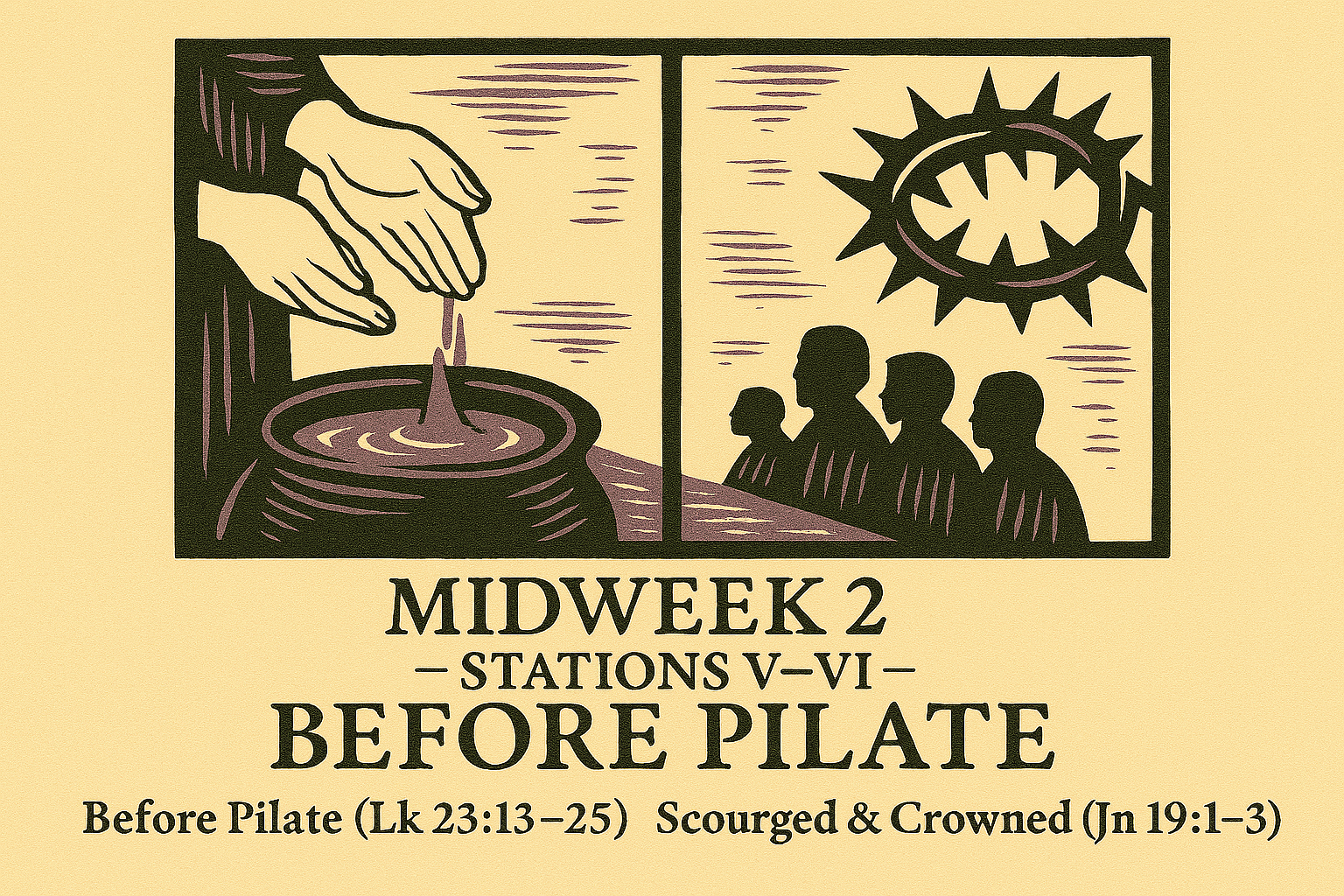
Luke 23:13-25
March 4, 2026
The murderer goes free while the innocent gets murdered. Do you see this theme everywhere in the pages of Scripture? Sure, Jesus is the fulfillment, the final and only sure sacrifice, but God continued to show the world, through Israel, that innocent blood must be shed for the guilty to be set free.
It should be no strange or foreign thing for those Jews to see. How many generations did the Lord show them, day after day, that the price for their sins was the blood of the innocent, and yet it was their sin which put the innocent on trial and ultimately condemned Him to be crucified. We may think to ourselves, “How could they miss the obvious message, displayed every day by the regular sacrifices at the temple?”
But what you have to understand is that ritual sacrifices were not uncommon among the people of the world. Pagan cultures all over the globe – to this day – have used sacrifice for various reasons. The Etruscans, the Egyptians, the Chinese, the Incas, the Aztecs, the Hawaiians, the Carthaginians, the Celts, the Vikings, and the list goes on. Animal and yes, human sacrifice, was and even today in some cultures, still is, considered vital to human existence.
But God, the one true God, setup the sacrificial system of the Jews for a very different reason. Whereas the rest of the world uses sacrifice to appease their gods and bring fertility, a good harvest, or other worldly aspirations, God used the sacrifices of lambs and birds to teach the people and prepare their hearts for the one final sacrifice for the sin of the whole world.
But Israel, enamored by the pagan cultures around them, always thought that the sacrifices were done to appease God so they could live their lives as they pleased. Never did they understand repentance – at least not for very long. Never did they understand the cost for their sins. For them, as long as they could keep the Lord happy, they wouldn’t have to worry about another Babylon.
And because they missed the point of the sacrifices, they also could not see that Jesus, in every way, was Himself a sacrifice. And so, blinded by their sin and lust for power and position, handed Him over to Pilate, the Roman governor of Jerusalem.
There was simply no Roman law by which Pilate could condemn Jesus to death. He was no insurrectionist, no rebel against Roman rule. He was no murderer or thief. Jesus did nothing wrong, not the least of which was a crime deserving of death.
He was spotless, unstained, unscarred by sin. Pilate wanted nothing to do with Him. But Pilate’s own past was replete with misdeeds and murder and mayhem. In fact, Pilate’s previous position led to the death of hundreds of people, and yet he wasn’t being crucified on the cross. He was as guilty as those Jewish leaders who sought Jesus’ death.
And Barabbas? Did you know his name means, “Son of the Father”? The Jews were crying out, “Free the son of the father,” while at the same time crying, “Put the son of God to death!” Even more interesting is Barabbas’ full name. According to the writings of the early church fathers, Barabbas’ full name was “Jesus Barabba,” Jesus, son of the father.
The Jews chose the murderer Jesus so that the innocent Jesus could be murdered. Barabbas would have died on the cross a deserved death for he was a murderer and a violent man, both by Jewish and Roman law. He would have deserved his crucifixion. But the one who deserved death because of his sins was set free and the One free from sin was secured to the cross, the same cross already prepared for Barabbas, for Rome had in mind to crucify three criminals that day.
The Jews did not know their sins and Rome didn’t care. The pharisees and religious leaders thought their works saved them, and Pilate was too concerned about his own reputation with Caesar to save the life of an innocent man. And God was crucified that day because of, not only the sins of the Jews, but the sins of the whole world.
The prophets had said this day would come. Even Moses wrote of this day in the Torah. But did those Jews, those Pharisees and Sadducees of the 1st century, ever think they’d be the ones to sentence the Creator of heaven and earth to die, the very God they claimed to worship? Of course not. For them, it was just another false teacher getting what he deserved, another blasphemer, stealing away their thunder, getting permanently displaced.
It should have all been clear to them – the crown of thorns, the purple robe, the lashings, that this prophet was not like any other. But their sin and their hunger for worldliness and their false religion of works-based self-righteousness was so engrained into their soul that they just could not see it.
And the crowds just followed whoever seemed to hold the other in check. For a while, when they thought Jesus would drive out Rome and return Israel to Davidic rule, they followed Him and leaned on His every word, that is until He said that they must eat his flesh and drink his blood or they have no life in them. For most of them, at that point, they returned to following rabbis and pharisees.
And so, the same crowd who cheered at His arrival in Jerusalem riding upon a donkey, they now jeered and hissed at Him and demanded His crucifixion because a crowd, even to this day, is easily swayed by the moment.
Well, this is all a wonderful and thought-provoking historical lesson, but is that all it is? Is this story just something that happened some 2,000 years ago and we just sort of know better now? Perhaps you think to yourself that you would not have been so quick to condemn this man, to want Him crucified. Perhaps you believe yourself stronger than Pontius Pilate who folded to the urging demands of the Jews for Jesus’ crucifixion. Perhaps you compare yourself to the shifting sands of the crowd and insist you would never betray Jesus that way, that you’d stick by Him thick and thin, come what may.
But need I remind you that St. Peter said the same thing. Need I remind you that Judas, one of the Lord’s chosen, sold Jesus to the Jews for a few gold coins. Need I remind you that the other disciples ran and hid, fearing that their own lives would be taken too.
Fact is that they were all sinners, and like the Jews who cried for His crucifixion, and like Pilate who washed his hands of Jesus’ death, we are sinners too. And every sin we commit of mind, of mouth or of motion is no different than those who sold Him, who sentenced Him or who pounded the nails into His hands and feet. Your sins caused Jesus’ crucifixion. You are responsible for the death of an innocent. And it doesn’t matter if it happened 2,000 years ago or two days ago. His death occurred because Adam disobeyed, and because Adam disobeyed, we all would stand in judgment for we have all disobeyed and sinned against the Lord, broken His commandments with impunity, and yes, even as Christians, as baptized children of God, we still sin and we even convince ourselves that the sins we commit aren’t all that sinful.
If we are not perfect in every way, then we are sinful in every way. And no rationalizing, no pragmatic approach to sin will make sin less sinful. Caiaphas the high priest, predicted that a man would have to die in order to strengthen Israel. Jesus’ death was expedient, practical, fortuitous…but it was still sinful that He should be murdered in such a way.
Pilate protected his own reputation and standing with Rome by putting Christ on the cross. But it didn’t make it right.
And when we sin, no matter if it seems expedient or practical or, like a sheep following the crowd, popular and “everyone else is doing it,” it is still sin and it still led to the death of an innocent man, the Son of God. It doesn’t matter if it’s cool, if all your friends are doing it, if it’s a great way to save money on taxes, if it helps you make money, if it helps you gain friends in life, if it’s politically correct, if it’s seemingly “unjudgmental” or “tolerant” or “culturally relevant,” if it is sin and if God’s commandments call it sin, then it led to God’s death on the cross.
No one escapes the charge because all have sinned and fallen short of the glory of God.
And here’s the amazing power and wisdom of God at work: God used your sin and your disobedience to bring justification to the world. He didn’t justify your sins and give you permission now to live sinfully and commit adultery or theft or any other covetous or godless thought, word or deed your little heart can invent, no, no, no. Sins are not made sinless or less sinful, and every sin must be punished in kind, by the only suitable punishment for sin there is – death.
But Jesus died. His body was pierced and His blood was shed, not yours. This means that in the eternal first universal bank of righteousness and sins, all the sins that you have committed as charges to your eternal account, all the debt you carry because of your sins, is wiped clean. In Jewish law it’s called the Year of Jubilee, when, every seven yers, all debts are forgiven a man and his slavery is ended. Jesus’ death on the cross means you live forever in this Jubilee Year because your sins are not counted against you ever.
And you are called now to daily repent, to acknowledge your sins, to confess that it’s true, that you have sinned against the Lord in your thoughts, words, and deeds, and to then believe with all your heart and mind and strength that His death has wiped your slate clean, charged you as innocent in God’s court, and balanced the accounts.
And out of reverent and humble response to this eternal change where God now calls you innocent, you now seek to live a life of virtue where you help your neighbor and lead your neighbor to the Gospel, to the baptismal font, and to the communion rail, here to the Kingdom of God where His Word and Sacraments forever pour down from the throne of heaven.
For if, after receiving this great and marvelous salvation, the forgiveness of your sins, you return to a life of sin and rebellion, like Barabbas who, according to tradition was quickly put to death for another violent murder or theft, then you will be charged and sentenced to death because you have profaned the cross of Christ and the price He paid for your freedom.
This is why you must continue to live a life of repentance, acknowledging your sins and leaning on the blood-stained cross of salvation so lovingly and graciously provided for you. To forsake the church is to forsake Christ. To forsake your baptism is to forsake Christ. To forsake the Lord’s Supper is to forsake Christ, and nothing, nothing, nothing should ever stand in the way of your salvation. For what can you gain in this life – what power or position or wealth or purpose can you achieve for yourself in this life – that even remotely compares to the life won for you and given freely to you by blood and water and Spirit and into the life to come?
What can you achieve by living sinfully and following the passions of your flesh in this life now, which is worth more than your freedom from sin and the eternal life that awaits you?
The only answer is nothing – nothing can compare to what Christ has achieved for you, won for you, done for you – not money, not career, not athletic prowess, not popularity, not a big house, not a fancy car, not a cute boy or girlfriend – nothing.
Therefore, repent, and turn from your sins and hold fast to His promises. Jesus will never abandon you or forsake you or leave you to your inner Pilate or inner pharisee but will always call you to confess your sins and lean on Him as He leads you to peace with God. Amen.